Back
Hana’s Kitchen
A cozy restaurant management game for learning Japanese
Concept
Mobile App
2025
Context
Games for language learning
People learning a language often watch TV shows or movies in that language to supplement their studying. In the same manner, games can also be used as a language learning tool. Through discussions with friends and online forums, I learned that people are actively seeking games they can play to learn a language, but few exist in the market. As someone learning Japanese, this sparked my curiosity: what would a game that helps you learn a language look like?
Solution
Cook Japanese dishes
Learn and practice vocabulary through taking orders, cooking, and serving customers.
Upgrade your restaurant
Purchase new equipment and decor to increase tips and make your customers happier.
Help Hana recover her memories
Help Hana, the previous owner of the restaurant, recover her memories.
Research
Researching learning methods
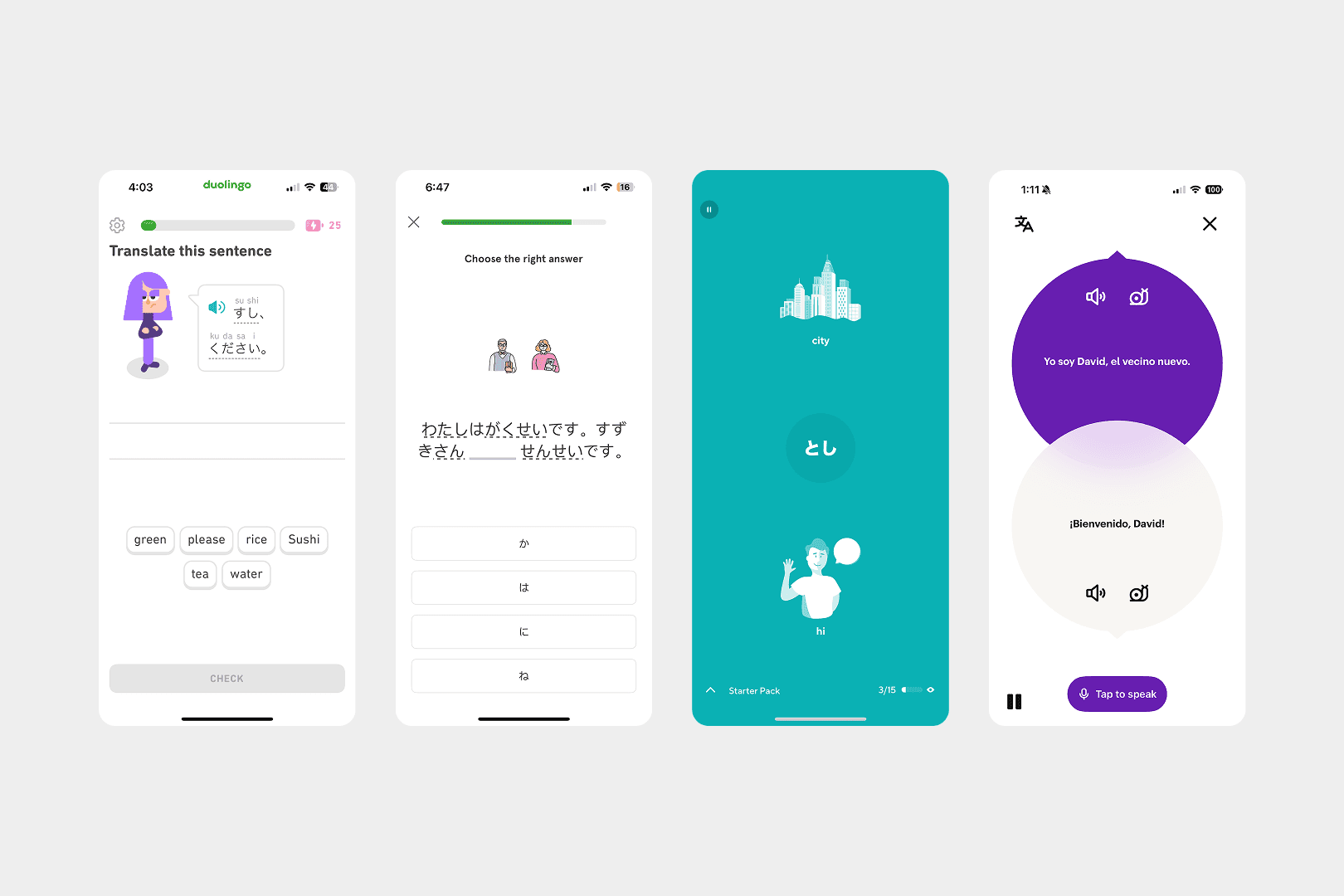
I researched different methods for learning a language by exploring popular language learning apps including Duolingo, Bunpo, Drops, and Babbel. Each app used a mixture of methods that fell into four categories: translation, grammar, speaking, and listening.
Popular language learning apps
Prototyping
Combining learning with gameplay
I explored a wide variety of ways these learning methods could be integrated into the game context. Here are some of the ideas that I explored:
Translate multi-step recipes
Translate ingredients
Fill in the blank to unlock recipes
Learn grammar from Hana
Practice speaking with characters
Listen to letters from characters
Testing
Testing with friends and family
I tested these prototypes with friends and family and observed how they felt playing the game, as well as how much Japanese they learned. I learned two key insights:

Players learn through repeated exposure
Players retained vocabulary like radish (daikon) after encountering them repeatedly across multiple contexts. When the same ingredient appeared on a recipe card, then in the cooking interface, then at Tanaka’s Supermarket, players naturally built recognition. This validated that vocabulary acquisition could occur without explicit translation drills.
Tasks should serve the game world
Players disengaged when tasks felt like language lessons inserted into gameplay. For example, translating Tanaka’s letter worked because it made sense that Tanaka would write a letter to you in Japanese. In contrast, there was no reason particles would be missing from a recipe beyond testing the player’s knowledge.
Iterating
Iterating on learning mechanics

Vocabulary: Repeated exposure across contexts
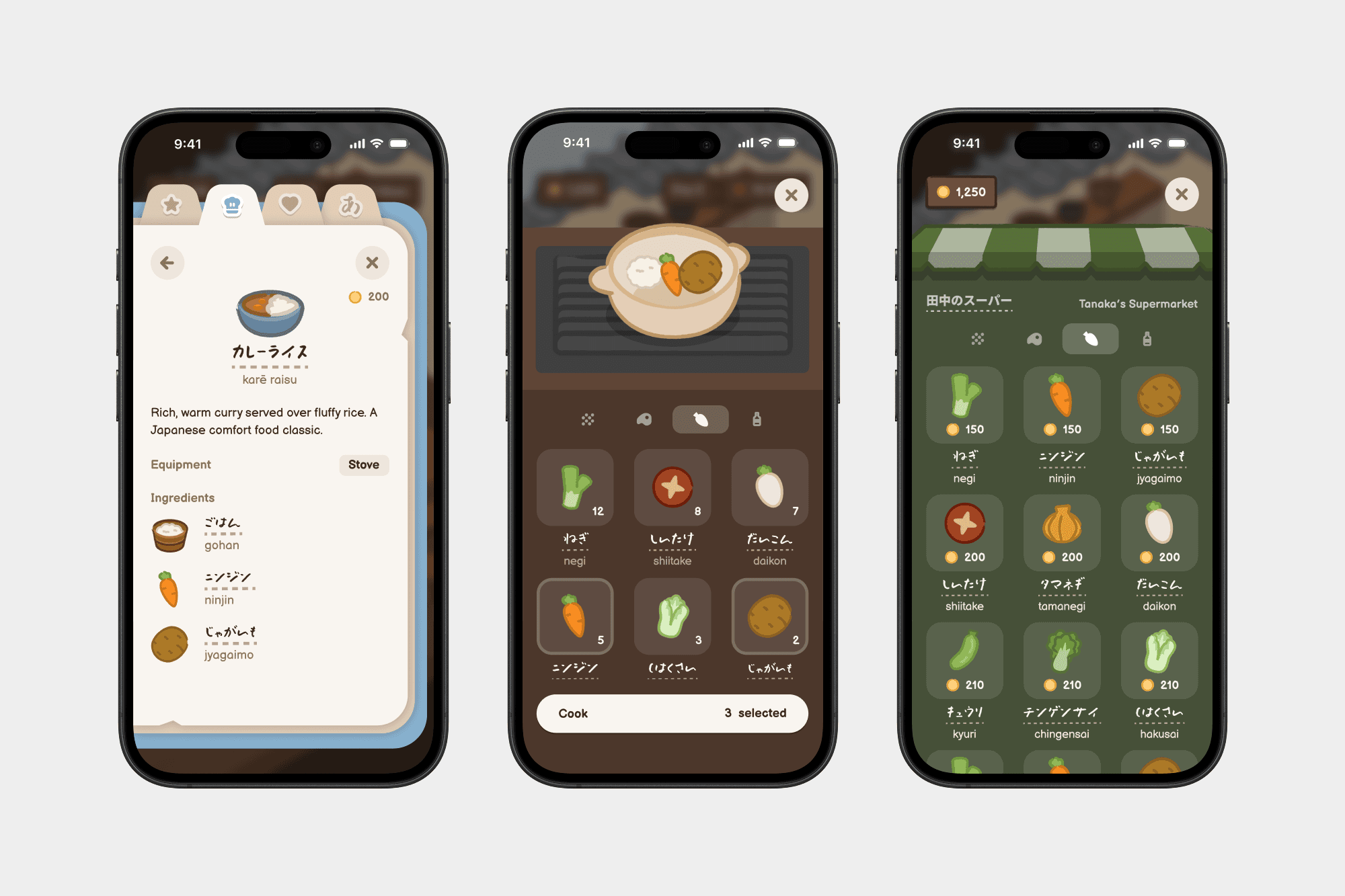
I mapped out vocabulary touchpoints to ensure each word appears at least 3-4 times per day cycle: on recipe cards, in the cooking interface, at the supermarket, and in customer dialogue.
Grammar: Contextual tooltips
I replaced explicit grammar lessons with tooltips. This preserved access to grammar learning for players who want it while keeping the core experience focused on play.
Speaking: Natural conversations with characters
I redesigned speaking moments so they felt like natural conversations, not “repeat after me” exercises.
Listening: Letters and memories
Key moments like receiving a letter or unlocking a memory function as opportunities to listen to native pronunciation and dialogue.
Thanks for reading!
Back to top
Back
Hana’s Kitchen
A cozy restaurant management game for learning Japanese
Concept
Mobile App
2025
Context
Games for language learning
People learning a language often watch TV shows or movies in that language to supplement their studying. In the same manner, games can also be used as a language learning tool. Through discussions with friends and online forums, I learned that people are actively seeking games they can play to learn a language, but few exist in the market. As someone learning Japanese, this sparked my curiosity: what would a game that helps you learn a language look like?
Solution
Cook Japanese dishes
Learn and practice vocabulary through taking orders, cooking, and serving customers.
Upgrade your restaurant
Purchase new equipment and decor to increase tips and make your customers happier.
Help Hana recover her memories
Help Hana, the previous owner of the restaurant, recover her memories.
Research
Researching learning methods
I researched different methods for learning a language by exploring popular language learning apps including Duolingo, Bunpo, Drops, and Babbel. Each app used a mixture of methods that fell into four categories: translation, grammar, speaking, and listening.

Popular language learning apps
Prototyping
Combining learning with gameplay
I explored a wide variety of ways these learning methods could be integrated into the game context. Here are some of the ideas that I explored:
Translate multi-step recipes
Translate ingredients
Fill in the blank to unlock recipes
Learn grammar from Hana
Practice speaking with characters
Listen to letters from characters
Testing
Testing with friends and family
I tested these prototypes with friends and family and observed how they felt playing the game, as well as how much Japanese they learned. I learned two key insights:

Players learn through repeated exposure
Players retained vocabulary like radish (daikon) after encountering them repeatedly across multiple contexts. When the same ingredient appeared on a recipe card, then in the cooking interface, then at Tanaka’s Supermarket, players naturally built recognition. This validated that vocabulary acquisition could occur without explicit translation drills.
Tasks should serve the game world
Players disengaged when tasks felt like language lessons inserted into gameplay. For example, translating Tanaka’s letter worked because it made sense that Tanaka would write a letter to you in Japanese. In contrast, there was no reason particles would be missing from a recipe beyond testing the player’s knowledge.
Iterating
Iterating on learning mechanics

Vocabulary: Repeated exposure across contexts
I mapped out vocabulary touchpoints to ensure each word appears at least 3-4 times per day cycle: on recipe cards, in the cooking interface, at the supermarket, and in customer dialogue.
Grammar: Contextual tooltips
I replaced explicit grammar lessons with tooltips. This preserved access to grammar learning for players who want it while keeping the core experience focused on play.
Speaking: Natural conversations with characters
I redesigned speaking moments so they felt like natural conversations, not “repeat after me” exercises.
Listening: Letters and memories
Key moments like receiving a letter or unlocking a memory function as opportunities to listen to native pronunciation and dialogue.
Thanks for reading!
Back to top
Back
Hana’s Kitchen
A cozy restaurant management game for learning Japanese
Concept
Mobile App
2025
Context
Games for language learning
People learning a language often watch TV shows or movies in that language to supplement their studying. In the same manner, games can also be used as a language learning tool. Through discussions with friends and online forums, I learned that people are actively seeking games they can play to learn a language, but few exist in the market. As someone learning Japanese, this sparked my curiosity: what would a game that helps you learn a language look like?
Solution
Cook Japanese dishes
Learn and practice vocabulary through taking orders, cooking, and serving customers.
Upgrade your restaurant
Purchase new equipment and decor to increase tips and make your customers happier.
Help Hana recover her memories
Help Hana, the previous owner of the restaurant, recover her memories.
Research
Researching learning methods
I researched different methods for learning a language by exploring popular language learning apps including Duolingo, Bunpo, Drops, and Babbel. Each app used a mixture of methods that fell into four categories: translation, grammar, speaking, and listening.

Popular language learning apps
Prototyping
Combining learning with gameplay
I explored a wide variety of ways these learning methods could be integrated into the game context. Here are some of the ideas that I explored:
Translate multi-step recipes
Translate ingredients
Fill in the blank to unlock recipes
Learn grammar from Hana
Practice speaking with characters
Listen to letters from characters
Testing
Testing with friends and family
I tested these prototypes with friends and family and observed how they felt playing the game, as well as how much Japanese they learned. I learned two key insights:

Players learn through repeated exposure
Players retained vocabulary like radish (daikon) after encountering them repeatedly across multiple contexts. When the same ingredient appeared on a recipe card, then in the cooking interface, then at Tanaka’s Supermarket, players naturally built recognition. This validated that vocabulary acquisition could occur without explicit translation drills.
Tasks should serve the game world
Players disengaged when tasks felt like language lessons inserted into gameplay. For example, translating Tanaka’s letter worked because it made sense that Tanaka would write a letter to you in Japanese. In contrast, there was no reason particles would be missing from a recipe beyond testing the player’s knowledge.
Iterating
Iterating on learning mechanics

Vocabulary: Repeated exposure across contexts
I mapped out vocabulary touchpoints to ensure each word appears at least 3-4 times per day cycle: on recipe cards, in the cooking interface, at the supermarket, and in customer dialogue.
Grammar: Contextual tooltips
I replaced explicit grammar lessons with tooltips. This preserved access to grammar learning for players who want it while keeping the core experience focused on play.
Speaking: Natural conversations with characters
I redesigned speaking moments so they felt like natural conversations, not “repeat after me” exercises.
Listening: Letters and memories
Key moments like receiving a letter or unlocking a memory function as opportunities to listen to native pronunciation and dialogue.
Thanks for reading!
Back to top
Games for language learning
Hana’s Kitchen
Researching learning methods
Combining learning with gameplay
Testing with friends and family
Iterating on learning mechanics
Back
Hana’s Kitchen
A cozy restaurant management game for learning Japanese
Concept
Mobile App
2025
Context
Games for language learning
People learning a language often watch TV shows or movies in that language to supplement their studying. In the same manner, games can also be used as a language learning tool. Through discussions with friends and online forums, I learned that people are actively seeking games they can play to learn a language, but few exist in the market. As someone learning Japanese, this sparked my curiosity: what would a game that helps you learn a language look like?
Solution
Cook Japanese dishes
Learn and practice vocabulary through taking orders, cooking, and serving customers.
Upgrade your restaurant
Purchase new equipment and decor to increase tips and make your customers happier.
Help Hana recover her memories
Help Hana, the previous owner of the restaurant, recover her memories.
Research
Researching learning methods
I researched different methods for learning a language by exploring popular language learning apps including Duolingo, Bunpo, Drops, and Babbel. Each app used a mixture of methods that fell into four categories: translation, grammar, speaking, and listening.

Popular language learning apps
Prototyping
Combining learning with gameplay
I explored a wide variety of ways these learning methods could be integrated into the game context. Here are some of the ideas that I explored:
Translate multi-step recipes
Translate ingredients
Fill in the blank to unlock recipes
Learn grammar from Hana
Practice speaking with characters
Listen to letters from characters
Testing
Testing with friends and family
I tested these prototypes with friends and family and observed how they felt playing the game, as well as how much Japanese they learned. I learned two key insights:

Players learn through repeated exposure
Players retained vocabulary like radish (daikon) after encountering them repeatedly across multiple contexts. When the same ingredient appeared on a recipe card, then in the cooking interface, then at Tanaka’s Supermarket, players naturally built recognition. This validated that vocabulary acquisition could occur without explicit translation drills.
Tasks should serve the game world
Players disengaged when tasks felt like language lessons inserted into gameplay. For example, translating Tanaka’s letter worked because it made sense that Tanaka would write a letter to you in Japanese. In contrast, there was no reason particles would be missing from a recipe beyond testing the player’s knowledge.
Iterating
Iterating on learning mechanics

Vocabulary: Repeated exposure across contexts
I mapped out vocabulary touchpoints to ensure each word appears at least 3-4 times per day cycle: on recipe cards, in the cooking interface, at the supermarket, and in customer dialogue.
Grammar: Contextual tooltips
I replaced explicit grammar lessons with tooltips. This preserved access to grammar learning for players who want it while keeping the core experience focused on play.
Speaking: Natural conversations with characters
I redesigned speaking moments so they felt like natural conversations, not “repeat after me” exercises.
Listening: Letters and memories
Key moments like receiving a letter or unlocking a memory function as opportunities to listen to native pronunciation and dialogue.
Thanks for reading!
Back to top